
PlayinMatch exchange · back or lay
PlayinMatch Exchange — Safe Back and Lay Odds to Trade From ₹100 a Bet
Back a side at the price you want, or lay it and take the bookmaker's seat yourself. The PlayinMatch exchange accepts either from ₹100 a bet, session lines from ₹50, and keeps 2% only of what you net on a settled market. Cricket markets go up roughly two hours before the first ball.

PlayinMatch Exchange Sign-In Before a Quick ₹100 Lay
Same username and password you use everywhere on PlayinMatch; once inside, the exchange slip refuses anything under ₹100 on a match market.
Try a ₹50 Session Line on the ExchangeReal Searches People Type About the PlayinMatch Exchange
- playinmatch exchange
- playinmatch exchange login
- playinmatch back lay
- playinmatch exchange commission
- playinmatch lay bet kaise kare
- playinmatch session bet
- playinmatch exchange minimum bet
- playinmatch cricket exchange
- playinmatch football exchange
- playinmatch exchange id kaise banaye
PlayinMatch Exchange Minimums Kept on One Safe Shelf
Safe ₹100 floor on the PlayinMatch exchange slip, back side and lay side alike
On the PlayinMatch exchange a back and a lay both begin at ₹100. Session and fancy lines come down to ₹50, which is usually where a first-timer tests how the slip behaves. Type a smaller figure and the stake box just will not confirm.
Cricket and football sit in the same PlayinMatch exchange list. Both prices on a runner are posted by other members rather than by a house book, and that member-against-member setup is the only reason laying exists at all.
Real 2% PlayinMatch exchange cut, worked out on a net market win
Your statement after the final ball is where this shows: ₹147 instead of ₹150 on a winning ₹100 back at 2.50, because PlayinMatch kept 2% of that market's net. Finish the market behind and no such line is printed.
| Back or lay minimum | ₹100 a bet |
|---|---|
| Fancy or session minimum | ₹50 a bet |
| Commission | 2% of the net win on a settled market |
| Cricket market opens | About 2 hours before the first ball |
Trading both sides of one runner is where the net rule pays off: back early, lay later, and the PlayinMatch exchange takes its 2% from the leftover profit only, never from each leg.
How a PlayinMatch Exchange Back Meets a Lay — the Real Matching Diagram
Every PlayinMatch exchange bet needs somebody on the other side of it. Back India at 2.50 and another member has laid India at 2.50; the two stakes get locked together until the match settles.
That pairing is the whole trick. A bookmaker writes its own prices and takes every bet against its own book. The PlayinMatch exchange writes nothing. Members post prices, other members accept them, and the site holds both stakes in the middle. So each runner carries two columns (back on one side, lay on the other) instead of a single number you either take or leave.
₹100 on Team A at 2.50.
Team A wins: you collect ₹150 profit.
Team A loses: your ₹100 goes to the layer.
Accept your ₹100 at 2.50.
Team A loses: they keep your ₹100.
Team A wins: they pay you ₹150 out of their liability.
Read it from either end and the money is identical. Either ₹150 travels left to right or ₹100 travels right to left. Nothing is created and nothing is skimmed while the match runs; the 2% comes later, from whoever finishes ahead on that market.
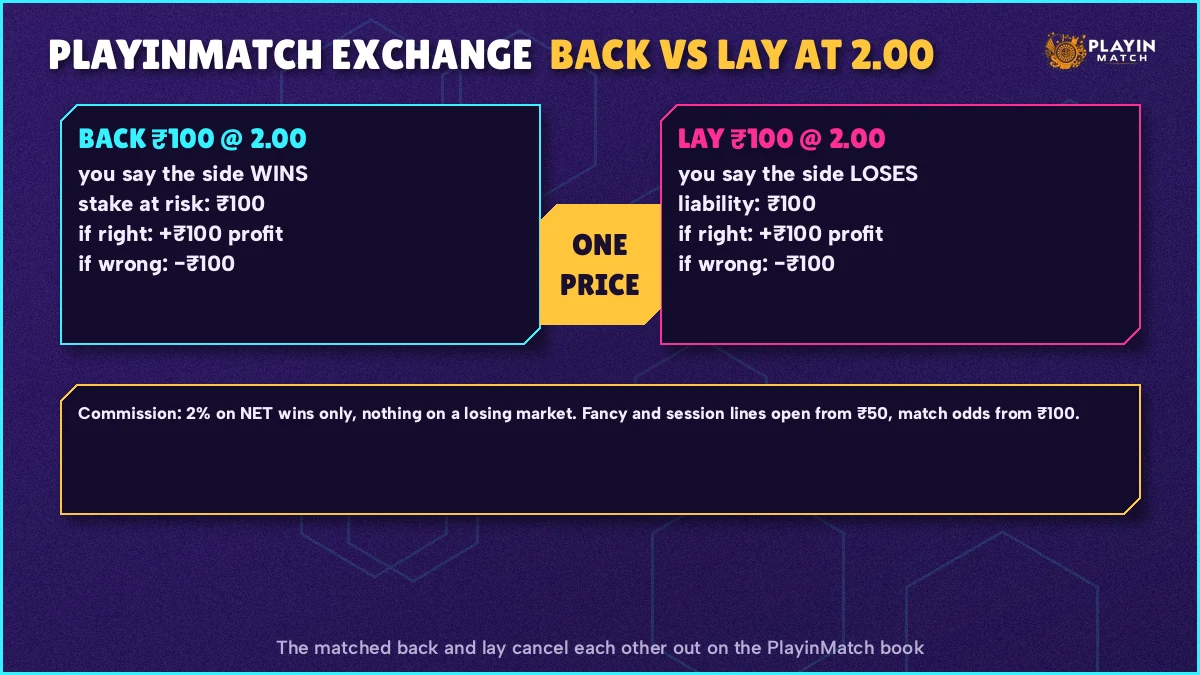
Prices on the PlayinMatch exchange are decimal, and one line of arithmetic reads all of them: profit on a back equals stake × (price − 1). At 2.50 a ₹100 back earns ₹150 profit and returns ₹250 with the stake. At 1.40 it earns ₹40. At 6.00, ₹500. Lay maths uses the very same bracket, only from the opposite chair, which is why the liability table further down looks like a mirror of this paragraph.
Suppose nobody wants your price. The slip then waits, unmatched, until another member takes it or you cancel it. How long? Hard to say. A big cricket fixture tends to fill small slips quicker than a quiet football game, which is simply how any market run by its own members behaves, and the PlayinMatch exchange is no different there.
Flip the roles and you are the layer. You are saying a side will not win, and you put up the money a backer would collect if you are wrong. That is a bigger idea than it sounds, so it gets its own section.
What Does a Lay Cost on the PlayinMatch Exchange? Safe Liability Maths
₹150. That is what a ₹100 lay at 2.50 on the PlayinMatch exchange puts on the line, worked out as stake times price minus one, and you pay it only if that team goes on to win. If it does not, the backer's ₹100 becomes yours. Do the sum before confirming.
Stake is what you win. Liability is what you risk. People mix those two up constantly on the PlayinMatch exchange, mostly because on a back slip they are the same number and on a lay slip they are not.
Here is the same ₹100 lay at five prices. Stake never changes; liability climbs fast.
| Price you lay at | Liability (you pay if the side wins) | You collect if the side loses |
|---|---|---|
| 1.50 | ₹50 | ₹100 |
| 2.00 | ₹100 | ₹100 |
| 3.00 | ₹200 | ₹100 |
| 5.00 | ₹400 | ₹100 |
| 11.00 | ₹1,000 | ₹100 |
Take the bottom row for a second. Laying an outsider at 11.00 with the minimum ₹100 stake means ₹1,000 of liability sitting against your PlayinMatch balance, for a ₹100 return. Short prices work the other way round: a lay at 1.50 risks half of what it can collect. Neither is good or bad on its own. The point is that the slip's stake box tells you only half of the story, and the liability figure is the half that decides whether your balance can carry the bet.
- Back stake
- What you put down on a PlayinMatch exchange back slip. Also the most you can lose on it.
- Lay stake
- The smaller figure on a lay slip, and the ceiling on what that lay can ever earn you, however long the price.
- Liability
- The ₹150 in the 2.50 example. PlayinMatch sets it aside the moment a member matches your lay and hands it back at settlement if the side loses.
- Net position
- All your backs and lays on one runner added together, per result. This is the figure commission is worked from.
A composite case from the desk's inbox. A member in Pune laid ₹100 on a chasing side at 3.00, about an hour before the first ball, then saw his PlayinMatch balance sitting ₹200 lower and messaged PlayinMatch customer care convinced money had gone missing. It hadn't. That ₹200 was the liability, parked until the result. The side fell short, the ₹200 came back, and his ₹100 win landed beside it less the 2% (so ₹98).
Two short rules come out of that table, nothing fancier. Before laying, check the liability fits the balance. After laying, expect the balance to look smaller until settlement, because on the PlayinMatch exchange that is the money doing its job, not money lost.
PlayinMatch Exchange Commission — a Proven 2% Taken From Net Wins Only
₹3 on a ₹150 win. ₹1 on a hedged trade that netted ₹50. Nothing at all on a match that went against you. Those three figures are the PlayinMatch exchange's 2% in practice, and the rows below show where each one comes from.
That sounds like 2% of every winning slip. It isn't, quite. The PlayinMatch exchange first adds up everything you did on one market, every back and every lay, and only then looks at whether the total came out positive. Three cases cover almost everything people ask about.
- Single back that wins
- ₹100 backed at 2.50 wins ₹150. Commission is 2% of ₹150, so ₹3, and ₹147 profit reaches your PlayinMatch balance with the stake.
- Single back that loses
- The ₹100 goes to the layer. No commission line appears, because there is no net win to take 2% from.
- Back, then lay the same runner
- Back ₹100 at 2.50, later lay ₹100 at 2.00. If the side wins you are +₹150 and −₹100, net ₹50, commission ₹1, ₹49 to you. If it loses you are −₹100 and +₹100, net zero, commission zero.
Row three is why traders like the PlayinMatch exchange's net rule. Two slips, two legs, one charge, and that charge only on the outcome that actually made money. Had commission been charged per slip, the winning leg would carry 2% even in the outcome where the trade broke exactly even. It does not.
Where to see it: after settlement, your statement shows the market result and the commission figure against it. A missing commission line on a settled market usually just means the market finished level or negative for you. On a market that is still running, there is nothing to see yet; the PlayinMatch exchange only works the 2% out once the result is in, which for cricket means after the last ball.
Proven PlayinMatch exchange trade, from a ₹100 back to an equal-profit lay
The net rule matters most when a price moves while you hold a position. Here is one ₹100 trade followed across the pre-match window, with every number worked through.
- Window opens
- You back Team A for ₹100 at 2.50 on the PlayinMatch exchange. Win: +₹150. Lose: −₹100.
- Price shortens to 2.00
- Team news goes Team A's way. A ₹100 lay at 2.00 locks +₹50 if A wins and ₹0 if A loses.
- Or split it evenly
- Lay ₹125 at 2.00 instead (₹100 × 2.50 ÷ 2.00). Win: +₹150 − ₹125 = +₹25. Lose: −₹100 + ₹125 = +₹25. Same ₹25 either way.
- Commission
- 2% of the ₹25 net comes to ₹0.50, so ₹24.50 reaches the balance whatever the result.
Now the awkward version. Say the price drifts to 3.00 instead of shortening. An even split would need a lay of roughly ₹83, and that is below the ₹100 floor, so the PlayinMatch exchange will not take it. The smallest lay you can place is ₹100 at 3.00, which leaves −₹50 if A wins and ₹0 if A loses. In practice, then, the floor shapes small trades: a member who wants room to split a position evenly in both directions tends to open with a bigger back than ₹100. That is arithmetic, not a tip.
The trade also runs backwards. Lay ₹100 at 2.00 first (liability ₹100), wait for the price to drift to 2.50, then back ₹100 there. Win: −₹100 + ₹150 = +₹50. Lose: +₹100 − ₹100 = 0. Mirror image of the first example, same single 2% on the positve outcome.
One more small thing, since it trips people. The 2% is per market. Profit on one match does not get offset against a a loss on another match when the commission is worked out; each market is counted on its own.
Cricket, Football and Session Lines on the PlayinMatch Exchange — Genuine Minimums
A ₹100 slip on a team, a ₹100 slip on a football side, or a ₹50 slip on a cricket number. That is the full menu on the PlayinMatch exchange, and the stake floor alone tells you which kind of market you are standing in before you read its name.
Cricket match odds are the busiest part of the PlayinMatch exchange, and they are the markets this page has been using for its examples so far. Each team is a runner, each runner shows a back price and a lay price, and the maths from the liabiity table applies unchanged. The ₹100 floor applies on both columns.
Football works the same way. A fixture lists its runners, you choose a column, the ₹100 minimum holds. Prices in a quieter football market can sit unmatched longer than on a big cricket night, which matters more for a lay than a back, simply because a waiting lay is a waiting liability too.
Football has one twist cricket match odds rarely do. Where a draw is listed as its own runner, a lay covers two outcomes at once. Lay the home side ₹100 at 2.00 and you owe ₹100 only if home wins; a draw or an away win both pay you the ₹100. Backing home covers one outcome out of three. On the PlayinMatch exchange that asymmetry is often the reason people lay in football at all, and it is the same liability formula underneath, nothing new to learn.
Quick ₹50 PlayinMatch exchange session lines, read the right way
Session and fancy lines are cricket-only and work on a number rather than a winner. The line names something countable, say runs by a particular over, and you take one side of that number. Stakes start at ₹50 on the PlayinMatch exchange, half the match-odds floor, which is why plenty of members start here before they ever lay a full team. The exact rate for each line shows on the slip at the moment you place it; I would rather you read it there than trust any figure printed on a page like this one.
Two things the session list is not. It is not in-play settlement, which has its own rules on the PlayinMatch live sports exchange page, along with the late-night markets. And it is not a scoreboard. If you want the runs and the current over beside you while a line is open, keep the PlayinMatch live score today page in another tab.
Between innings, some members drift off to the casino side for a round or two. Same wallet as the PlayinMatch home lobby, different floors; the PlayinMatch game lobby lists those, and none of its minimums apply on the exchange. Keep the two sets of numbers apart in your head (the exchange floor is ₹100, full stop, unless it is a session line).
When Do PlayinMatch Exchange Markets Open? A Quick Two-Hour Window
A cricket market on the PlayinMatch exchange usually opens about two hours before the first ball. Before that the fixture may be listed elsewhere on the site, but there is nothing to back or lay yet. Football fixtures carry their own start time on the list; check it there.
Those two hours are the busiest pre-match stretch. Team news arrives, the toss lands inside the window, and prices shift every time either happens. Slips placed at the very start of the window tend to see the most movement afterwards; slips placed close to the first ball see less. That is just observation, not advice, and the PlayinMatch exchange takes either at the same ₹100 floor.
A first lay inside that window goes in four moves. Pick the runner you think will not win. Tap its lay column rather than its back column; the two sit side by side and are easy to swap on a small screen. Enter a stake of ₹100 or more and read the liability next to it. Confirm only if your balance covers that liability, then watch the slip move from waiting to matched. Every one of those moves has a number from this page attached to it, which is the point: on the PlayinMatch exchange nothing on the slip should surprise you after the toss.
The floor counts per slip, by the way, not per market. Three ₹100 lays on the same match are three separate bets, each one at the minimum, and their liabilities stack.
If a match is abandoned, what happens to matched stakes is set out in the PlayinMatch terms and void-market rules. Read that once before your first lay rather than during a rain delay.
Safe fixes when a PlayinMatch exchange slip will not confirm
Most refused slips come down to the same short list. Match the message, or the symptom, to the row.
- Stake rejected on match odds
- It is under ₹100. Raise it to ₹100 or more and place it again.
- Stake rejected on a session line
- It is under ₹50, the session floor.
- Market not showing
- You are probably earlier than the two-hour window. Come back nearer the first ball.
- Lay refused though the stake is fine
- Your PlayinMatch balance cannot hold the liability this lay creates. Drop the stake, choose a shorter price, or add funds first; deposit steps sit on join PlayinMatch.
- Balance lower than expected
- Liability from an open lay is being held. It returns at settlement.
- No commission on a winning slip
- The market as a whole netted zero or less, or it has not settled yet.
- Slip sitting unmatched
- No member has taken your price. Wait, cancel, or move the price nearer the current one.
Still stuck after that? Message the desk with the market name and the slip time. Withdrawing a PlayinMatch exchange profit is a separate process, and its timings live on the PlayinMatch withdrawal time page.
PlayinMatch Exchange Questions With Real Answers
What is the minimum bet on the PlayinMatch exchange?
₹100 a slip on cricket match odds or football, back or lay. Cricket session and fancy lines go down to ₹50. Below either floor the PlayinMatch exchange slip simply does not confirm; bump the figure up to the floor for that market and try once more.
How is commission charged on the PlayinMatch exchange?
PlayinMatch charges 2% on your net win from each market, worked out after the market settles. All your backs and lays on that market are added together first. If the total is a profit, 2% of it is taken; if it is zero or a loss, nothing is charged at all.
Is laying riskier than backing on the PlayinMatch exchange?
Yes, at long prices. A ₹100 lay at 5.00 on the PlayinMatch exchange puts ₹400 at stake to win ₹100, while a ₹100 back can never lose more than ₹100. Short prices narrow the gap: at 1.50 the lay risks only ₹50. Compare liability with your balance before confirming.
When does a cricket market open on the PlayinMatch exchange?
Cricket markets on the PlayinMatch exchange open roughly two hours before the first ball. Earlier than that the fixture has nothing to back or lay. Prices usually move most inside that window, around team news and the toss, and the ₹100 minimum applies throughout.