
PlayinMatch safety checks you can repeat
Is PlayinMatch Safe — Real Checks: the ₹1,00,000 KYC Line, OTP on New Phones, Payout Record
Judge PlayinMatch by what it does with your money and your phone, not by a rating. Three things can be checked from your own account: when documents get asked for, what happens when you sign in on a new handset, and whether payouts reach the bank account in your own name.
Test Whether PlayinMatch Is Safe From Your Own Real Account
Every check below runs inside a live PlayinMatch login, so sign in once on the phone you normally use; a second handset later will show you the OTP step for yourself.
Ask the Desk Where Your ₹1,00,000 KYC Count StandsSix Real Checks That Answer “Is PlayinMatch Safe” for Your Own Wallet
Nobody can hand you a safety certificate for a betting brand. What you can do is run six small tests and watch whether PlayinMatch behaves the same way every time.
We picked these six because each one ends in something you can see: a prompt on your screen, a message from the desk, a credit in your bank app. None of them needs trust in a stranger's review. If PlayinMatch fails one, you will know within a day, and you will know which one.
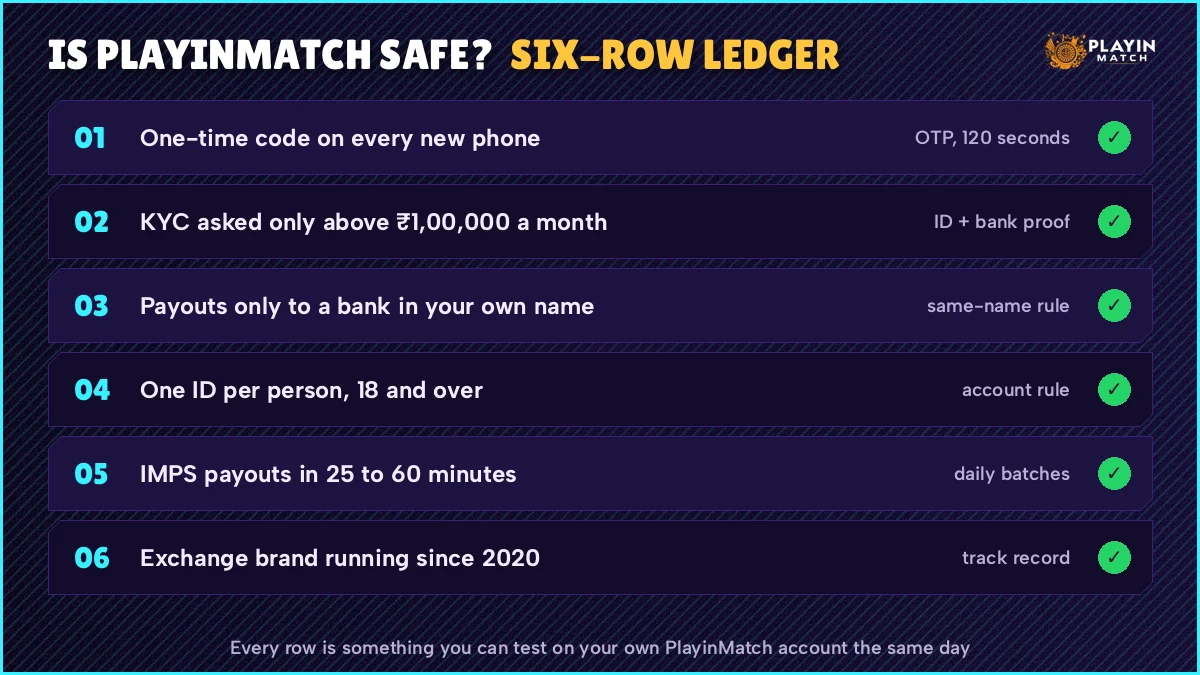
- 01The KYC line. Ask the desk how much you have withdrawn this month. Documents are only requested once the running total passes ₹1,00,000, so a smaller account should never be chased for papers.pass = no papers below the line
- 02The new-phone OTP. Sign in to PlayinMatch on a handset you have never used for it. A one-time code should appear before the wallet does.pass = code before balance
- 03The name match. Add a bank account in a name that differs from yours, then ask the desk whether it can receive a payout. It should not.pass = refused
- 04The first payout. Withdraw the smallest amount allowed and time it against the published batch hours.pass = inside the window
- 05The unblock request. Read what the desk wants when an account is locked. Username and a deposit reference, yes. Your password, never.pass = no password asked
- 06The written rules. Open the terms and find the one-ID rule, the 18+ rule and what happens to stakes on an abandoned match.pass = all three in writing
Checks 01 and 02 are the ones this page explains in full, because nowhere else on the site covers them. The other four point to the PlayinMatch page that owns the detail, so you are reading the source rather than a copy.
A small aside: run them across a week, not an evening. A brand can look tidy for one night. Seven days of normal use, two payouts and one new phone tell you far more.
When a PlayinMatch Safety Check Fails — the Quick Next Step
A failed check is not automatically a scam. Most of the time it is a setting, a name spelt two ways, or a request sent at the wrong hour. The table below is how we would read each failure before deciding anything about PlayinMatch.
| Check | Likely reason | What to do |
|---|---|---|
| 01 KYC asked early | Your monthly total is higher than you thought | Ask the desk for the running figure |
| 02 No OTP on a new phone | The handset was used for this ID before | Try a phone that has never opened it |
| 03 Other-name account accepted | Unlikely; treat it as a warning | Stop and raise it with the desk |
| 04 Payout past the window | Name mismatch, KYC, bonus rollover or a closed batch | Use the complaint format on the problem page |
| 05 Password requested | The message is not from PlayinMatch | Do not reply; change the password |
| 06 Rule missing from terms | You may be reading an older copy | Open the current terms page |
Row 03 is the only one where we would stop outright. A brand that lets money leave to a stranger's account is not protecting anyone, including you.
PlayinMatch KYC at ₹1,00,000 a Month: the Real Running-Total Rule
PlayinMatch asks for identity documents only when your withdrawals in a single month add up to more than ₹1,00,000. Below that cumulative figure the account runs on the details you gave at sign-up. Above it, the desk asks for KYC before releasing further payouts.
The word that matters is cumulative. It is not one big withdrawal that trips the line. It is the running total.
A Worked PlayinMatch KYC Example With Real Numbers
Picture a member in Pune who withdras ₹40,000 in the first week, ₹35,000 in the second and then asks for ₹30,000 near the end of the month. The first two requests total ₹75,000, comfortably under the line, and nothing extra is asked. The third pushes the month to ₹1,05,000. That request is the one where PlayinMatch asks for documents, and until they are in, the payout can sit as pending.
That example is ours, built to show the arithmetic; your own figures will differ. The principle does not.
Whether the month runs by calndar date or from your first request is something we would confirm with the desk rather than guess. Ask before a large month, not in the middle of one.
Why does a threshold count as a safety signal at all? Two reasons. First, a brand that demands passport scans from every new member collects far more personal data than it needs, and data that is never collected cannot leak. Second, a brand that never asks, at any amount, is handing large sums to whoever controls the login. PlayinMatch sits between those: light at small amounts, firmer once real money is moving out.
Timing is the catch. The withdrawal that crosses ₹1,00,000 is, almost by definition, a big one, and that is when a member least wants a hold. On the PlayinMatch withdrawal problem page, pending KYC appears as one of the named causes behind a slow payout. Send papers in the week before a heavy month and the hold never shows up.
So, in practice: below ₹1,00,000 a month, expect no paperwork. Above it, expect a request, and treat it as normal rather than as a red flag.
OTP on Every New Phone — a Real PlayinMatch Safety Step You Can Watch
Each time a PlayinMatch account is opened on a device it has not seen before, a one-time password is sent and must be typed before the wallet loads. Your username and password alone are not enough on a new handset. That is the whole check, and you can trigger it yourself in about a minute.
Borrow a family member's phone. Open the sign-in drawer, enter your PlayinMatch username and password, and stop. If the next screen asks for a code rather than showing your balance, check 02 has passed.
Why the PlayinMatch New-Phone Code Matters More Than a Strong Password
Passwords leak in boring ways. Someone watches you type it at a tea stall; a cousin remembers it from the time you let him place a bet on your phone; you reused it from an old shopping account. The OTP turns each of those into a dead end, because the person holding the password is not holding your SIM.
It also tells you something about the operator. A PlayinMatch account that does not challenge a new device is protected by one secret. One that does is protected by two, and the second lives in your pocket.
- New phone, correct password
- OTP requested before the wallet opens
- New phone, wrong password
- No code is sent; repeated misses lead to a temporary lock (timing on the login page)
- Same phone, normal sign-in
- Straight in with username and password
- Code arrives, you did not ask for it
- Someone has your password; change it and tell the desk
The last row is the useful one. An unexpected PlayinMatch code on your phone is not spam. It means a sign-in attempt from a device that is not yours just reached the second gate and stopped there. Change the password the same day.
How long the code stays valid, and what to type in which field, is covered on the PlayinMatch login page; we will not duplicate the timing here. If repeated failures leave you locked out, the request format for an unblock sits with the PlayinMatch customer care number page, and it does not include your password.
Is PlayinMatch Real or Fake in India? A Proven Bank-App Timing Test
PlayinMatch is real in the sense that matters to a bettor: withdrawals are paid by IMPS to a bank account in the member's own name, inside batch hours the brand publishes. A fake operator takes deposits easily and finds reasons not to pay. The payout record is where that difference shows.
So test the payout, not the deposit. Any site can take money.
Start with the smallest withdrawal PlayinMatch allows. The floor, the per-request cap, the IMPS window and the batch hours are all on the PlayinMatch withdrawal time page, and we would rather you read them there than trust a figure copied onto this one. Note the time you send the request. Note the time your bank app shows the credit. If the gap is inside the published window, check 04 has passed.
Three Signs a PlayinMatch Payout Record Is Genuine
- The money lands only in an account whose name matches the PlayinMatch profile. A request to a friend's account gets refused, and that refusal is protection, not obstruction.
- A late payout comes with a named cause. The withdrawal problem page lists them, and each has a fix.
- Payout proof is posted where members can see it, through the Telegram proof channel linked from that same page.
One composite case we hear often: a member requests a payout at two in the morning, sees nothing by breakfast and assumes the worst. Then the credit arrives mid-morning. Nothing was wrong. The request simply missed the last batch of the night and waited for the first one of the day. Knowing the batch hours turns a frightening night into an ordinary one.
That is the the useful test, then. Not whether a payout is ever slow, but whether a slow PlayinMatch payout has an explanation you could have read in advance. When the reason is name mismatch, KYC pending, unrolled bonus or a closed batch, you can fix it. When there is no reason at all, that is the moment to raise it with the desk, using the complaint format on the problem page.
Real PlayinMatch Review Searches From Safety-Minded Players
- is playinmatch safe or not
- playinmatch review india
- playinmatch real hai ya fake
- playinmatch legal hai kya
- playinmatch owner name
- playinmatch kyc limit
- playinmatch otp new phone
- playinmatch payout proof
- playinmatch fraud or genuine
PlayinMatch Review Ledger — Safe, Legal and Real-or-Fake Questions
Is PlayinMatch Safe, Measured by the Checks on This Page
Anyone asking is PlayinMatch safe usually wants one yes or no. We cannot give that for every reader, but this page gives six tests that answer it for one wallet: yours. The KYC line at ₹1,00,000 a month and the OTP on a new phone are explained in full above.
A fair PlayinMatch review comes down to repeatable behaviour, so the cluster of questions people search splits roughly like this:
- playinmatch review: judged by the six-check ledger, not star ratings
- for readers wondering whether playinmatch is real or fake in india, check 04 above uses nothing but your own bank app and a clock
- playinmatch is legal in india: answered in the plate further down, together with the ISP-block point that confuses most readers
- playinmatch owner name: not published on this site, and not guessed
Where the PlayinMatch Legal and Owner Questions Land on a Real Review
Both questions get a straight answer further down, including why we print no owner name and why the legal question is a state-by-state one.
- KYC trigger
- Withdrawals above ₹1,00,000 in a month
- New-device rule
- OTP before the wallet opens
- Payout account
- Same name as the profile only
What a Genuine PlayinMatch Desk Never Asks You For — Safe Habits That Hold
Most real losses in this market do not come from the operator at all. They come from someone pretending to be the operator. Knowing what the genuine PlayinMatch desk has no reason to request is the cheapest protection there is.
We built this list only from how the service actually works. If a message asks for something on it, the message is wrong, whoever it claims to come from.
The rule underneath every row: PlayinMatch already has what it needs. Anything beyond that is somebody else fishing.
- Your password
- An unblock needs your username and the UTR of your last deposit. The password is not part of that request, so nobody genuine needs it.
- Documents below the line
- A small PlayinMatch account has no paperwork for anyone to collect. If an unknown number starts chasing an Aadhaar photo while your month is nowhere near the threshold, it is not the desk talking.
- The new-phone OTP
- The code exists to prove the person signing in holds your SIM. Reading it out to anyone defeats its only purpose.
- A payout to another name
- Payouts go only to an account matching your profile. Someone offering to route your winnings through their account is offering to keep them.
- Extra app permissions
- The genuine PlayinMatch Android file asks for a single storage permission (the details are on the app download page). An APK that wants contacts or SMS is a different file.
- Money for a predictor
- Aviator rounds use a Spribe provably-fair seed that predictor and hack apps cannot read. Paying for one buys nothing.
On that APK row, one more thing. Copies of the PlayinMatch app sitting on third-party download sites fail the signature check, which the PlayinMatch old version APK page goes through. Older official builds may still sign in, but a stranger's mirror of the file is not something we would install on a phone that holds your banking app.
Fair question back at us, too. On playin-match.pro the two drawers that slide in from the right are demonstrations; whatever you type there stays on your screen. Server log retention and the cookie position are spelled out in the PlayinMatch privacy policy, so a reader checking PlayinMatch can check this page by the same standard.
PlayinMatch Owner Name, Legal Status and Our Real Review Verdict
Who Runs PlayinMatch — the Genuine Record We Can Show
We do not have a named owner of PlayinMatch on record, so this page does not print one. Several sites answer the owner name search with a person's name and no source. We would rather leave the line blank than fill it with a guess that could be wrong about a real human being.
What is on record is shorter and more useful: how long the brand has been running and what it covers, both set out on the about PlayinMatch page. Longevity is not proof of honesty. Still, an operator that has paid members through several cricket seasons has a record you can ask other players about, and that is worth more than a name.
Is PlayinMatch Legal in India? A Real Answer Without Overreach
Rules on online betting in India are written state by state, so the PlayinMatch safety question splits in two. The platform side, which is what this page covers, you can test yourself inside a live login. The legal side depends on where you sit, and nothing here is legal advice. One signal people misread: a PlayinMatch address that stops loading on Jio or Airtel. That is a provider block, and the mirror list on the home page carries your ID straight across it.
Two things are within your control. You must be 18 or older, and you get one ID per person; both sit in the PlayinMatch terms and conditions, next to the void-market rule for abandoned matches and the bonus rollover. Read those three before a first deposit.
PlayinMatch Review Verdict — Safe Enough to Test, With Real Limits
Our view, after laying it all out: PlayinMatch has the controls you would want from an exchange brand. Documents are asked for at a sensible threshold rather than at sign-up. A new phone triggers an OTP. Payouts are locked to your own name and run in published batches, and late ones come with a named cause. That is a reasonable foundation.
It is not a promise. No page can tell you a betting account is risk-free, and this one will not try. The point of the six checks is that you stop relying on our verdict, or anyone's, and rely on what PlayinMatch does with your own small withdrawal and your own spare phone.
If the checks pass and you keep playing, set limits first. The PlayinMatch responsible gaming page explains the weekly deposit cap, the self-pause and a full close. Then head back to the PlayinMatch home page for the rest of the lobby.
Is PlayinMatch Safe? Quick Answers to Real Player Questions
Is PlayinMatch safe to use in India?
Safe enough to test, in our view, because you can verify it yourself. Open PlayinMatch on a spare phone and an OTP should block the wallet. Withdraw a small amount and it should reach only a same-name bank account. Paperwork appears past ₹1,00,000 a month. Your own habits, like keeping codes private, do the rest.
Is PlayinMatch real or fake?
The practical test is a payout. Request the smallest withdrawal PlayinMatch allows, note the time, and compare the bank credit against the published batch hours. A real operator pays inside its own stated window and gives a named reason when it cannot. A fake one takes deposits and invents delays.
Is PlayinMatch legal in India?
This page cannot rule on it for you. The position changes with the state you live in, so read your own state's rules first. What PlayinMatch itself enforces is narrower: no member under 18, one ID per person, and mirror addresses with the same balance for days when an internet provider blocks the main one.
Who is the owner of PlayinMatch?
We do not have a published owner name for PlayinMatch, so we do not print one or guess. Treat any site naming an owner without a source with caution. The about page sets out how long the brand has been running, which is a more useful thing to check than a name.
Why does PlayinMatch ask for an OTP on my new phone?
The code proves the person signing in also holds your SIM. PlayinMatch sends it whenever the account opens on a device it has not seen before, so a stolen password alone cannot reach your wallet. If a code arrives that you did not request, change your password the same day.
When does PlayinMatch ask for KYC documents?
Only after your payouts for the month pass ₹1,00,000 in total. Until then PlayinMatch works from your sign-up details and no papers are needed. The request lands on whichever withdrawal crosses that figure, and it can hold that payout as pending, so a member expecting a heavy month should send documents first.
Will the PlayinMatch desk ever ask for my password?
No. When an account needs unblocking, the desk works from your username and the UTR of your last deposit. Your password is not part of that request. Anyone asking for it, or for your new-phone OTP, is not acting for PlayinMatch, whatever name or logo the message carries.